
New technologies
A Thousand Garages
Before there is a printer in space, there has to be a shipyard on the ground, and the shipyard does not have to be in one place
Every time somebody talks about manufacturing in space, the picture is the same. A printer in orbit, or on the Moon, or out in the Belt, turning local rock into parts. I have written two articles arguing for exactly that, and I still believe it. But there is a step in front of it that nobody wants to talk about, because it is not exciting, and it is the step that actually decides whether any of the rest happens.
Before there is one printer in space, there have to be thousands of printers on the ground.
Here is the problem in plain terms. Gerard O'Neill worked out fifty years ago that the way to keep people healthy off Earth is to spin them.1 A rotating structure big enough to give you something like a full gravity at the rim without making you sick is on the order of a mile across. I have written about why bones need that, and about one way you might hollow out a rock big enough to hold it. Set those aside. Say you want to build the thing out of parts, the way we build everything else. What does the bill of materials look like?
It looks like a hundred thousand of the same part. Then another hundred thousand of a slightly different part. Panels, ribs, brackets, frames, trays, fittings. Not one of anything.
And there is no factory on Earth tooled to make that, because there is no customer for it. Nobody has placed the order. A shop that could do it would have to be built first, and nobody builds a factory for a customer who does not exist yet. That is the bottleneck, and it is on the ground, and it has nothing to do with rockets.
The shipyard that is not in one place
We have solved this problem before. In 1941 the United States needed cargo ships faster than anybody could build them, and the answer was not a bigger shipyard. It was to build the ships in pieces, in factories all over the country, and ship the pieces by rail to the yards to be welded together.2 The first Liberty ship took most of a year. By 1943 the average was about six weeks, and 2,710 of them got built before the war was over.3 The people who did the work in those inland plants had, for the most part, never built a ship and never would. They built a bulkhead, or a deckhouse, or a section of double bottom, to a drawing, and sent it down the line.
That is a distributed shipyard. The yard was still the yard. It did the assembly and the welding and the launching. But the fabrication was spread across the country to wherever there was a building and some people who could read a print.
Now put a metal 3D printer in that picture instead of a press brake and a welding crew, and the whole thing gets easier. A printer does not need a skilled operator to read the drawing. It reads the file. Send the same file to a thousand printers of the same model and you get a thousand parts that are, within the limits of the machine, the same part. The human hand is out of it. What normally makes distributed fabrication impossible, a thousand shops each interpreting the drawing a little differently, is the one thing a printer removes.
People will do this. Twenty years ago a project called Folding@home asked ordinary people to run a piece of software on their home computers overnight to simulate how proteins fold. In the spring of 2020 that network of volunteer machines crossed an exaflop of computing power, faster than any supercomputer on Earth at the time.4 That was people donating idle computers to a cause. I am proposing something more direct: people getting paid, per accepted part, to run a machine in their garage.
What a garage can actually make
This is where the idea either lives or dies, so I looked at what a garage printer can do today rather than what I wish it could do.
True laser metal printing, the kind where a laser fuses a bed of metal powder, is still a shop-floor machine. The lower end of that market is being called "prosumer," and it starts around sixty thousand dollars and runs to two hundred.5 That is not a garage machine for most people. Hold that thought, though, because it matters later.
What a garage can run is a good filament printer, the same kind that prints plastic, loaded with a metal filament. The filament is mostly stainless steel powder held in a plastic binder. The printer lays it down like plastic. Then the part goes through a debinding step and into a furnace at thirteen or fourteen hundred degrees Celsius, where the binder burns off and the steel particles fuse into a solid part that shrinks a predictable amount and comes out with the properties of ordinary 316L stainless. [Editor’s note, September 2026: that last clause was too generous. A sintered part is weaker than wrought 316L, by about half in yield. The correction, with sources, is in Cold, Vacuum, and a Hundred Thousand Joints.]6 Most people mail the green part off for that step. The printer itself is a six hundred dollar machine.7
And here is the number that shapes everything else. The build volume on the printers people actually own is about 256 millimeters on a side. Call it ten inches.7
Ten inches. That is your panel.
Why ten inches is good news
My first instinct was that this killed the idea. You cannot build a mile-wide structure out of ten-inch pieces. Then I did the arithmetic, and it turns out the small part is what makes the geometry easy.
A mile in diameter is about 16,600 feet around. At ten inches a panel, that is roughly twenty thousand panels in one ring around the rim. That is a big number, but it is a big number of the same thing, which is exactly what a network of printers is good at. And it is the reason the network has to be thousands of machines, not a few. One printer is a demonstration. Ten thousand of them, each making the same ten-inch panel over and over, are a shipyard.
Then look at the curve. I worried that a curved panel could not slide into place, because a curved piece has to slide along an arc, not a straight line. But at a half-mile radius, the middle of a ten-inch panel bows out from a straight line by about four ten-thousandths of an inch. That is less than the tolerance of the printer. The panel is flat. The curve is real, but it lives in the angle between one panel and the next, not inside any panel. Twenty thousand flat pieces, each tilted a hair from its neighbor, make a circle. This is the same trick a geodesic dome uses to fake a sphere out of straight struts, and it means every garage prints a simple flat-sliding part and the curve takes care of itself.
No bolts, no welds
Now the part I have actually been chewing on, and where I want to be knocked down if I am wrong.
A hundred thousand panels means a hundred thousand joints, and I do not want a hundred thousand bolts. Bolts need a torque, a tool, a hand, and a check. Welds need a welder and an inspector. Out there, both need a suit. I want the panels to slide together and lock, and I want the structure itself to be the thing that holds them.
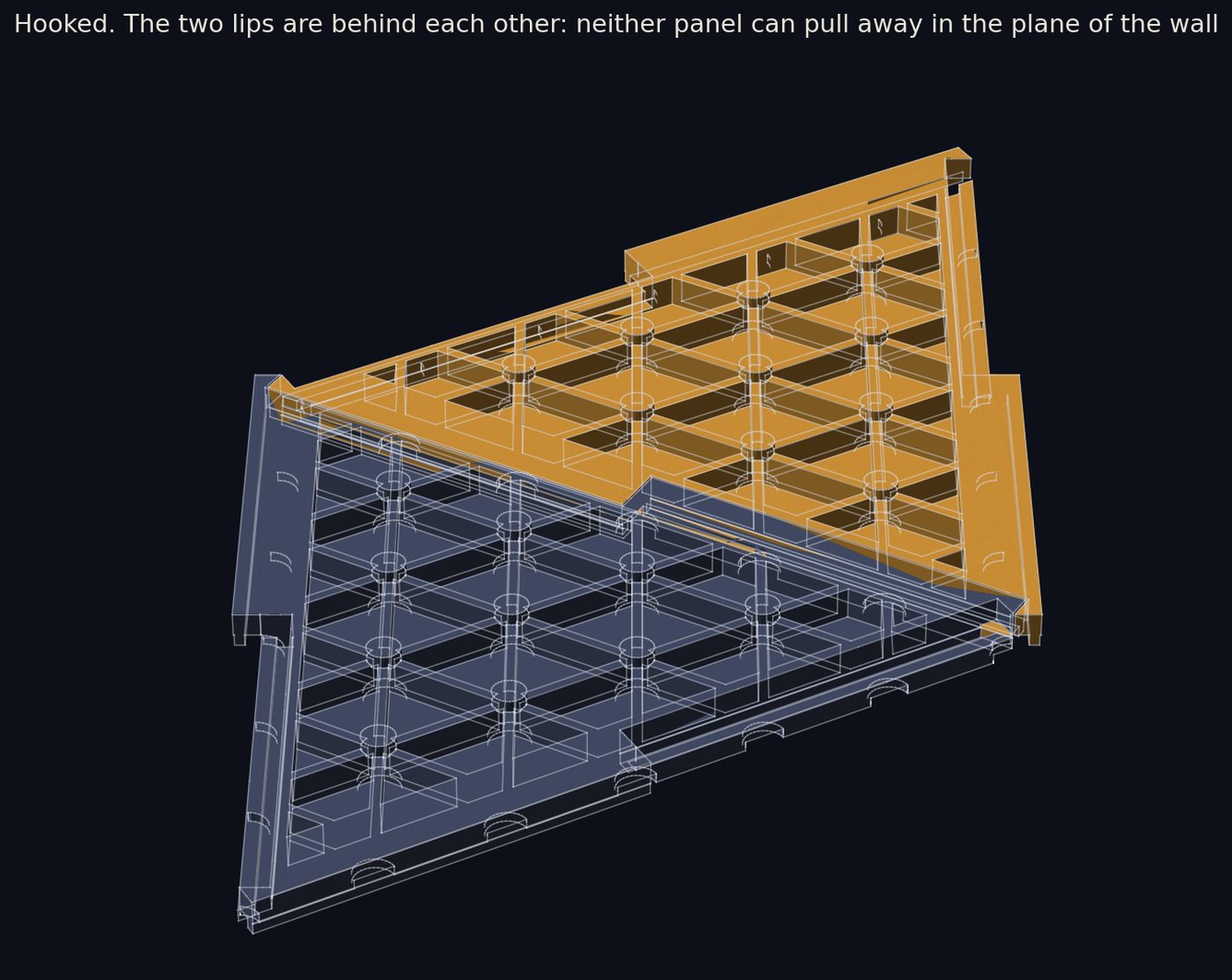
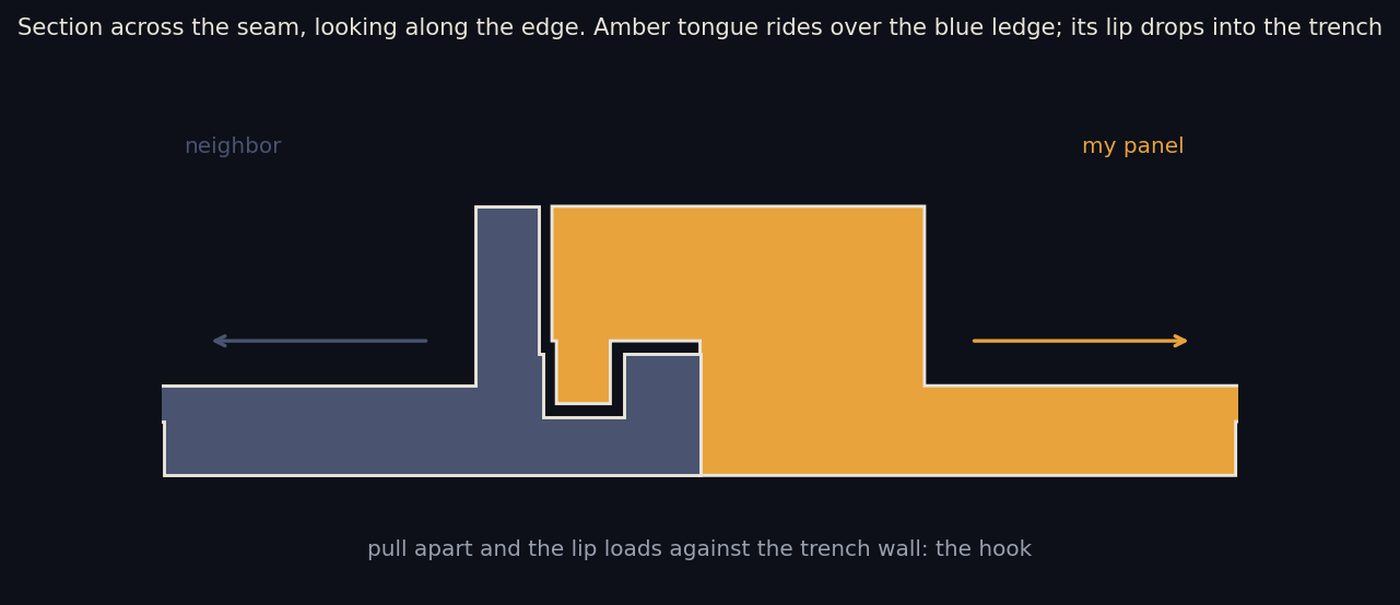
The joint I keep coming back to is old. Timber framers have used a sliding dovetail for centuries: a tapered tongue that slides into a tapered slot from the side, gets tighter the farther it goes, and cannot come out any direction but the way it went in. It carries load in every direction except that one. On a bench it is a strong joint. On a spinning barrel it is better than strong, because of what the spin does.
Think about the load. Once the barrel is turning, every panel in the rim is being pulled outward, hard, all the time. That pull is at right angles to the direction the panel slid in. The joint is being loaded exactly the way a dovetail wants to be loaded. The spin is the fastener.
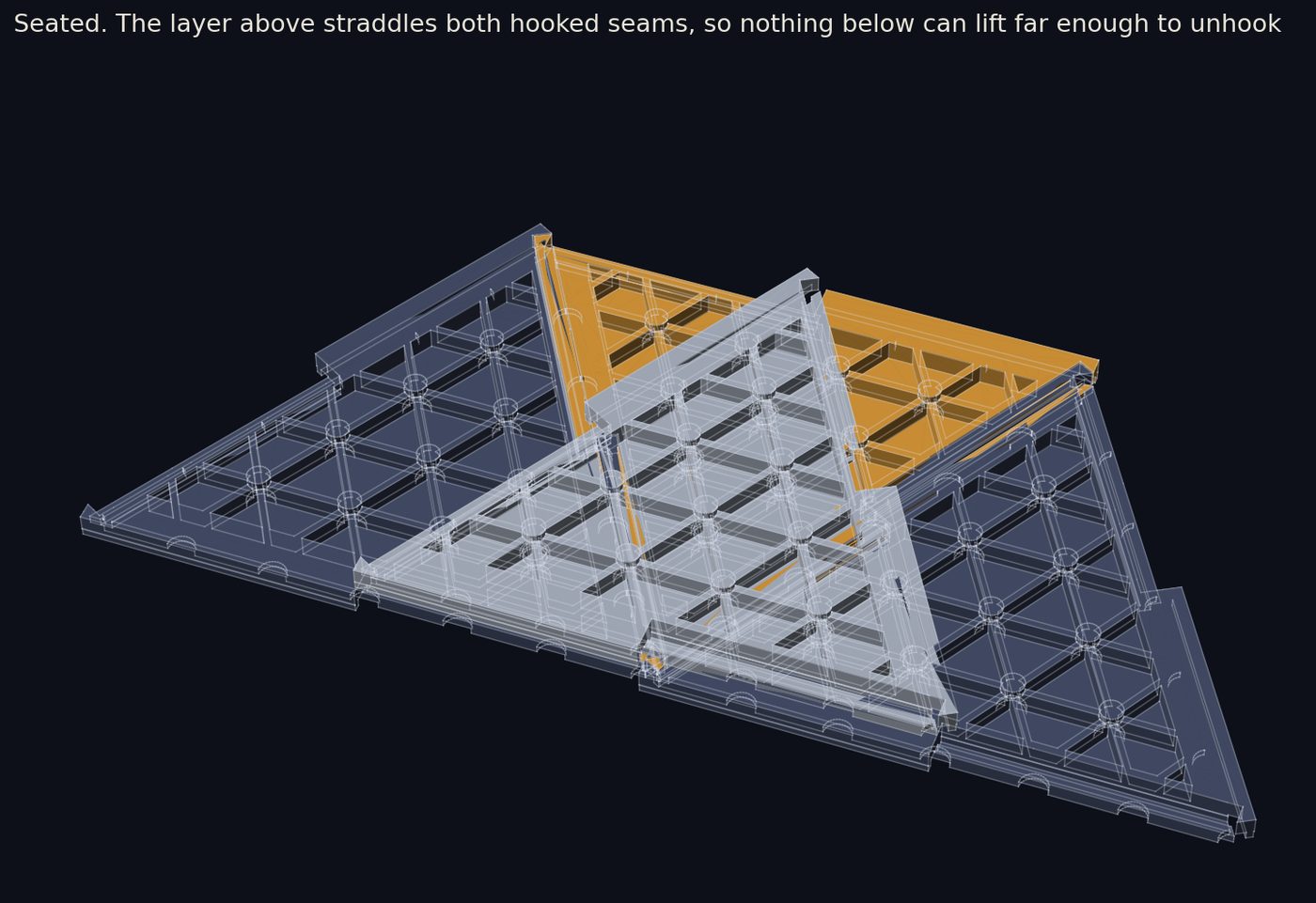
What that does not handle is the one direction the joint is weak in: sliding back out the way it came, during the launch shake or before the barrel is up to speed. And the answer to that is not hardware. It is brickwork. Stagger the courses. Lay each ring of panels offset by half a panel from the ring beside it, and every panel's slide path is crossed by the panels above and below it. Nothing can back out because its neighbors are lying across the exit. The only panel that ever needs a pin is the last one in each course, the keystone, and that is one pin per ring instead of a bolt per part.
The structure gets stronger as it goes together rather than depending on a hundred thousand separate locks each holding on its own. And a flat panel with a tongue on two edges and a slot on the other two packs into a rocket fairing far better than anything with latches sticking out of it, which is how SpaceX has been launching Starlink: flat-packed in a stack, held by tension rods, released all at once when the stack reaches orbit.8 A stack of panels is a better payload than a stack of satellites. It has no moving parts.
The part nobody wants to talk about
Now the objection, and it is a real one, and I would rather raise it myself than have somebody in a plant somewhere raise it for me.
A part out of a garage has no material traceability. No heat lot on the filament. No record of the furnace cycle. No weld procedure, because there is no weld, but also no procedure of any kind that anyone signed. No nondestructive examination. If you have ever wondered why a pressure vessel carries a stamp, this is why. The stamp says that a chain of people, each of whom could lose their license, attested to the material, the process, and the inspection of that part. A hundred thousand garages do not produce that chain. They produce a hundred thousand parts and a hundred thousand shrugs.
So the honest version of this idea has to include the answer, and the answer is the one the Liberty ships already gave us. The yard is still the yard.
The network prints to a spec. Every part ships to a central shop. That shop does what a fab shop's quality department does now: receiving inspection, dimensional check against the drawing, coupon testing from every filament lot, a sample of parts cut up and looked at, and a stamp on what passes. The garages are fab shops. The central shop is the yard, and it owns the quality package. Parts that fail get scrapped and the printer that made them gets a call. That is not a new system. It is the system every piece of equipment I have ever commissioned came through, and it works.
It also tells you which parts the garages should make. Not the pressure hull. Not anything whose failure kills somebody. Secondary structure, brackets, interior framing, soil trays for the farm, fittings, the ten thousand small parts that nobody wants to tool up for and that a habitat is mostly made of. The structural panels, the ones the spin is pulling on, come from the other tier.
Two tiers, and where the money comes from
Remember the sixty-thousand-dollar machine. That is the second tier.
Nobody buys a sixty-thousand-dollar laser printer for a cause. But a shop will buy one, or five, for a purchase order. That is how every shop I have ever worked in got its equipment: somebody had a contract, so they went to the bank. A standing order for structural panels, at a price, with a spec and an inspection regime, is the thing that turns a fabrication vendor into a supplier. It solves the qualification problem at the same time, because now there is a business with a name on it and something to lose if a part fails. And a thousand of those shops, each with a few machines running around the clock, is more capacity than any single factory anybody will ever build for this.
So the network is two things at once. Thousands of garages on cheap machines making the non-critical parts, paid per accepted piece. Hundreds of shops on real machines making the structure, on contract. Both feeding one yard that inspects, stamps, and packs the parts flat into stacks for Florida. Nobody in that chain has to believe in space colonization. They have to believe the check clears.
What is already being worked on
I want to be fair about how much of this is new, because less of it is than I expected. NASA Langley has a patented interlocking joint for autonomous in-space assembly, with built-in guiding geometry so pieces self-align as a robot brings them together.9 There is a paper from this year's AIAA SciTech conference specifically on designing a snap-fit connection for in-space assembly and manufacturing.10 Robotic assembly of modular truss structures has been demonstrated on the ground.11
What I notice in all of it is that the joints almost always end up with something extra: a captive screw, a spring latch, a magnet, a rotating hook. The pure geometric lock, where the structure holds itself, is rare for structural joints, and I think that is because those designs are for structures that do not spin. Mine does. The spin is what lets the joint be dumb. If somebody who does this for a living can tell me why that is wrong, I want to hear it.
What I am doing next
I am going to print some. Not the mile-wide version. A handful of ten-inch panels in plastic, with the tongue and slot and the stagger, small enough to fit on the bed of the printer, so I can slide them together on a bench and find out whether the joint does what I think it does. If it binds, or rocks, or the tongue snaps off at the root, I will write that up too, because that is the point of the exercise.
If you run a printer, and you want to print a couple and tell me what you find, write in. If you run a shop with a laser machine and you have an opinion about what a purchase order would have to look like before you would put a second one on the floor, I want that even more. The ground side of this is where it gets decided, and the people who decide it are not at a space agency. Some of them are reading this.
From one explorer to another, we appreciate you reading this far. We are excited about what this endeavor brings, and we would like you along for the rest of it.
Come join us. Because we are Star Bound.
John LangEditor
Ideas in Star Bound are published open — take them, build them better. Our open proposal.
A note on where this comes from. I am not a metallurgist, a spacecraft engineer, or a degreed engineer of any kind. But I am a practical one, with more than forty years in heavy industrial construction: welding, millwright work, hydraulics, mining, and thirty-three years of electrical construction and commissioning on the North Slope of Alaska, in a place that punishes anything built wrong. Much of that time I have worked as a field engineer, which means I am the one standing in front of the equipment when the drawing turns out to be wrong, and the fix has to be made on the spot, with what is on hand, and has to work the first time. Anyone who has done that long enough learns that a lot of engineering gets corrected in the field by people with more experience than the people who drew it. That is the eye I bring to these subjects: not what should work on paper, but what actually gets built, and what breaks. The facts I take from other people are footnoted so you can check them and read further. The ideas built on top of those facts are my own, and I would rather see them knocked down by somebody who knows better than left standing because nobody looked.
Sources
- Gerard K. O'Neill, The High Frontier: Human Colonies in Space (1976) — the rotating-habitat argument, discussed in Bones Don't Travel Well. ↩
- Bowdoin College, On the Prow of Liberty — subassemblies built at factories around the country and shipped by rail to the yards. ↩
- Smithsonian National Museum of American History, Model, Liberty Ship — 2,710 built; construction time falling from about 230 days to 42, with three ships a day launched in 1943. ↩
- Network World, Thousands of PCs break exaFLOP barrier (April 2020) — volunteers rising from 30,000 to 700,000 in weeks, and the network passing an exaflop. ↩
- 3D Tech Valley, Best 3D Printer for Metal (2026) — the "prosumer" laser powder-bed class priced between roughly $60,000 and $200,000. ↩
- 3D Universe, BASF Ultrafuse Metal Filament; Call3D, How to Print Real Metal Filaments — debinding, sintering at 1300–1400 °C, predictable shrinkage, and finished parts matching conventional 316L. ↩
- Bambu Lab, Compare Bambu Lab printers — P1S at $599 with a 256 × 256 × 256 mm build volume. ↩
- Spaceflight Now, Starlink satellite deployments continue; Everyday Astronaut, Starlink 18 — flat-panel satellites stacked in the fairing, held by retention rods, released as one piece; up to 60 per Falcon 9. ↩
- NASA Technology Transfer, Assemblers — the SSS-Joint interlocking joint system with built-in alignment features for autonomous in-space assembly. ↩
- AIAA SciTech Forum 2026, Designing a Snap-Fit Connection Appropriate for In-Space Servicing, Assembly, and Manufacturing. ↩
- NASA, Test Results for Autonomous Assembly of Modular Space Structures — a UR10e arm joining structural modules and load-testing the connection. ↩
The sliding dovetail, the geodesic approximation of a curve by flat facets, and the circumference and sagitta arithmetic for a one-mile ring are standard joinery and geometry and are not footnoted individually. The two-tier network, the spin-as-fastener argument, and the staggered-course lock are my own proposals.
More from Star Bound
- Top of the Loop, Bottom of the LoopThe two animals nobody budgets for, and what happened the last time we forgot them
- Light Is the ThrottleWhat a mine in Idaho and a garden in Alaska taught us about growing things fast — and what continuous daylight does to a plant that never gets to sleep
- Commission It FirstWe have already run phase one. It cost one man 150 million dollars of his own money, and it very nearly killed the people inside.
- Life in the BarrelO’Neill gave us the barrel in 1976 and got very little of it wrong. What he did not finish was the inside — and the standard the inside has to meet isn’t twenty years. It’s forever.
- Worms: The Backbone of CivilizationWhy the first Martians will need a bucket of worms more than another rocket
- Send the Robots FirstWhy the road to Mars runs through the moon, and why the first lunar miners will never leave Earth
- Wet the Ground and WaitA passive water generator for the desert, and why we should build one before we need one on Mars
- Send the Refinery, Not the OreWhy the belt gets mined by factory ships, and why that is the one job we cannot run from a chair
- Grind the Asteroid, Print the PartWhy there will never be a steel mill in space, and what replaces it
- Powder or WireThe two ways to print metal, why neither one is ready for the Belt, and the questions somebody has to answer first
- Bones Don't Travel WellThe one problem no rocket solves, and why Gerard O'Neill worked out the answer in 1976
- Blow the Rock Like GlassMy father's answer to how you build something big enough to spin, and the man who worked it out in 1963
- Built for Earth, or Built for Something Bigger?The tools a colony needs are being perfected right now, by people who say they are building them for us
- Mission Watch: September 2026What private enterprise and the agencies actually did this summer, in the order that matters
- The Question I Asked Buzz AldrinIn 1996 I asked the second man on the Moon what part private enterprise would play in space. Thirty years later, the answer is checkable
- Sixteen Inches of SteelThe number that breaks the mile-wide barrel, four ways around it, the one we would bet on, and a file you can print tonight
- Fish, Salt, or DirtThree ways to feed a habitat, what each one costs you, what each one can't survive, and a question for the reader.
- Thirty Thousand Volts and a Piece of Tin FoilI drove an hour and a half to call a man a liar. He turned on a computer monitor instead, and I have been thinking about it for twenty years.
- A Message in a Bottle, Thrown HardEvery article in this magazine is about how to build something. This one is about how to pay for it.
- The Box Nobody TestedIn 1991 eight people were sealed inside three acres of glass to prove a closed world could keep them alive. It nearly didn't, and the reason was sitting in the walls the whole time.
- Out the Side of the MountainTwenty miles of vacuum tube under a Hawaiian volcano, and a freight train that never comes back down. What a ground-based mass driver would actually take, and why it exits the flank instead of the summit.
- That’s Not a Rocket, It’s a Freight TrainHow I wired the one on my bench in 1994, the one I drew and never built, and why a mass driver runs on railroad logic, not rocket logic.
- Launch the Parts, Not the ShipYou cannot launch a habitat big enough to spin. So you launch a shipyard, and you let the robots build it.
- Cold, Vacuum, and a Hundred Thousand JointsWhat geosynchronous orbit does to the ten-inch panels in "A Thousand Garages," starting with the question every steel man asks first — and one thing that article got wrong.
- One Press or Ten ThousandElon Musk casts a car underbody in one shot with a machine the size of a house. We proposed ten thousand garages. It turns out we may both be right, on different walls — but nobody knows until somebody breaks fifty panels on purpose.
- Cast It or Print ItThree ways to make a hundred thousand habitat panels. What each one buys you, what each one costs you, and where each one belongs. The first entry in a department that exists to write both columns down.
- Powder or PlateThe garages stay. What's in them changes.
- Refuel It or Strip ItThe graveyard belt is the closest junkyard we've got.
Comments
Star Bound is not a forum, so comments run the old way: if you have comments, please write to us at hello@starboundmagazine.com and they will be published here in the next update, with your name on them. Say if you would rather stay anonymous.
No comments posted on this one yet. Yours could be the first.