
Habitats
Sixteen Inches of Steel
The number that breaks the mile-wide barrel, four ways around it, the one we would bet on, and a file you can print tonight
Last week I proposed building a rotating habitat out of ten-inch panels printed in thousands of garages.1 I meant it, and I still mean it. But I have spent the days since then doing the thing I should have done first, which is the arithmetic on the wall, and I owe you the number before I owe you anything else.
The number is sixteen inches. That is how thick a steel hull has to be to hold one atmosphere of air inside a barrel a mile across. Not for strength against the spin. For the air.
Here is where it comes from, and then here is what we do about it, and then I am going to ask you for help, because I do not think one editor in Alaska is going to solve this one alone.
The air is the load
Everybody who thinks about a spinning habitat thinks about the spin. You picture the rim being flung outward and the wall straining to hold it in. And that load is real. But for a steel shell carrying itself at one gravity out at a half-mile radius, the spin stress works out to something like nine thousand pounds per square inch, which is a number a structural steel is comfortable with. Spin is not the problem.
The problem is the fourteen and seven-tenths pounds on every square inch of the inside of the wall, pushing out, all the time, over a surface a mile across. The formula is the same one that sizes every pressure vessel and every pipe I have ever hooked up on the Slope: the stress in the wall equals the pressure times the radius, divided by the wall thickness. Nothing exotic. What kills you is the radius. A pipe is a few inches across. A pressure vessel is a few feet. This thing is eight hundred meters, and the wall has to be thick in proportion.
Run it. Sea-level pressure, a half-mile radius, and an allowable stress of two hundred megapascals, which is a fair working number for ordinary steel with a margin on it, and you get a wall four tenths of a meter thick. Sixteen inches. Cut the pressure in half, which is what the NASA habitat studies of the 1970s assumed, and you get eight inches.2 Better, but still not a part anybody is printing in a garage, and still not a joint anybody is sliding together by hand.
And the weight of that hull, if it has to come up from Earth, is the part that ends the conversation. Sixteen inches of steel is about six hundred and fifty pounds per square foot. Wrap that around a barrel a mile across and a kilometer long and you are looking at something on the order of sixteen million tons of steel before a single deck goes in. At a hundred-odd tons per launch on the biggest rockets flying, that is more launches than have happened in the history of spaceflight. The mile-wide, single-shell, one-atmosphere barrel built from parts launched off the ground does not survive that page. I want to say that plainly so nobody thinks I am hiding it.
It is worth noticing what O'Neill did with this same number. He knew it. His answer was not to make the wall thinner. It was to make the wall out of the Moon, mined and thrown into orbit by a mass driver, so that meter-thick walls cost him rock instead of rocket fuel.3 That is a fine answer if you already have a lunar mine. We are trying to build the first one from the ground, so we do not get to use it.
One more thing the formula says, and it is a hard one for me, because it cuts against a piece my father worked on. If you hollow out a rock and spin it and pressurize it, the rock shell goes into tension. Rock is strong in compression and nearly worthless in tension. A blown glass bubble of stone does not hold air by itself. It needs a liner, and the liner is the same sixteen inches. The rock still buys you shielding and mass, and I will come back to that. It does not buy you the wall.
Four ways around it
The formula has three things in it you can change, and there are exactly four moves I can find that make the wall a part instead of a monument. All four work the same way. None of them ask one wall to carry the whole diameter.
Put the load somewhere else. A plate holding pressure is a bad structure. A cable is a good one. If you run tension members across the inside of the barrel, hoop to hoop, in a lattice, they carry the pressure load in pure tension, which is what steel is best at, and the wall only has to hold the air across the short span between anchors. A suspension bridge deck does not carry the river. The cables do. The wall in that picture is a skin, not a vessel, and a skin can be panels.
Compartmentalize. The radius in the formula is the radius of whatever is holding the air. If the habitat is made of cells, each cell's wall only sees its own radius. Ten cells across the diameter and the wall is a tenth as thick. This is not a new idea, and here is the part that surprised me. The Stanford torus, the famous NASA design from 1975, is a mile across, but it is a tube. The tube is a hundred and thirty meters in diameter, and that is the radius its wall sees. At half an atmosphere, in aluminum, the study came up with a skin about two centimeters thick.4 Less than an inch. The 1975 study did not build a barrel. It built a compartment and bent it into a ring, because the wall arithmetic told it to, and it got a wall that a panel can be.
What you lose is the cathedral. You do not get the open mile of sky with farms on the far side of it. You get a ring of rooms, or a bundle of tubes. What you gain is a structure that can actually be built, and one that does not lose all its air through one hole. I have been on enough jobs to know which of those matters when something goes wrong.
Lower the pressure. Half the pressure is half the wall, for free, if you raise the oxygen fraction to make up for it. NASA has been working toward exactly that for the next generation of habitats, an eight-psi cabin with the oxygen bumped up above thirty percent, because it also makes spacewalks easier.5 The catch is fire. The Apollo 1 crew died in a cabin of pure oxygen at sixteen psi, and the material rules that came out of that accident still govern every wire and every scrap of fabric in a crewed vehicle.6 Oxygen-rich air is a design constraint on everything you put inside, and it is one more reason the structure should be metal and the plastic should be limited.
Build small and multiply. A barrel a hundred meters across needs a couple of inches of wall at full pressure. That is a part. A hundred of those, docked together or strung on a spine, hold as many people as the mile-wide one. Every one of them is a copy of the first, which is the only kind of thing a network of garages is any good at making anyway.
What we would bet on
All four at once, honestly, but in a particular arrangement. Here is the proposal as it stands this week, and I want it understood as a proposal and not a plan.
The habitat is a cluster of cells, not a single shell. Each cell is sized so that its own wall, built from the panels we already have, holds the air. The cells are tied to each other and to a central spine with tension members, so no cell's wall ever sees the whole diameter, and the spin load runs through cable, which is the right material for it. The pressure is somewhere below one atmosphere with the oxygen up, and the interior is designed for that air from the start.
The panel itself has changed since last week, and this is where I have been spending my evenings. It is no longer a flat square with a sliding dovetail. It is an equilateral triangle, ten inches on a side, because triangles will tile a curve and squares will not, and because a triangle cannot rack. It is not solid plate. It has a thin skin and a grid of triangular ribs standing off the back, what the aerospace people call an isogrid, and I will tell you something about that which still surprises me: the ribbed version is cheaper to print than the solid one, because to a printer the ribs are just infill and the empty space costs nothing. That is the opposite of every other fabrication process I know.
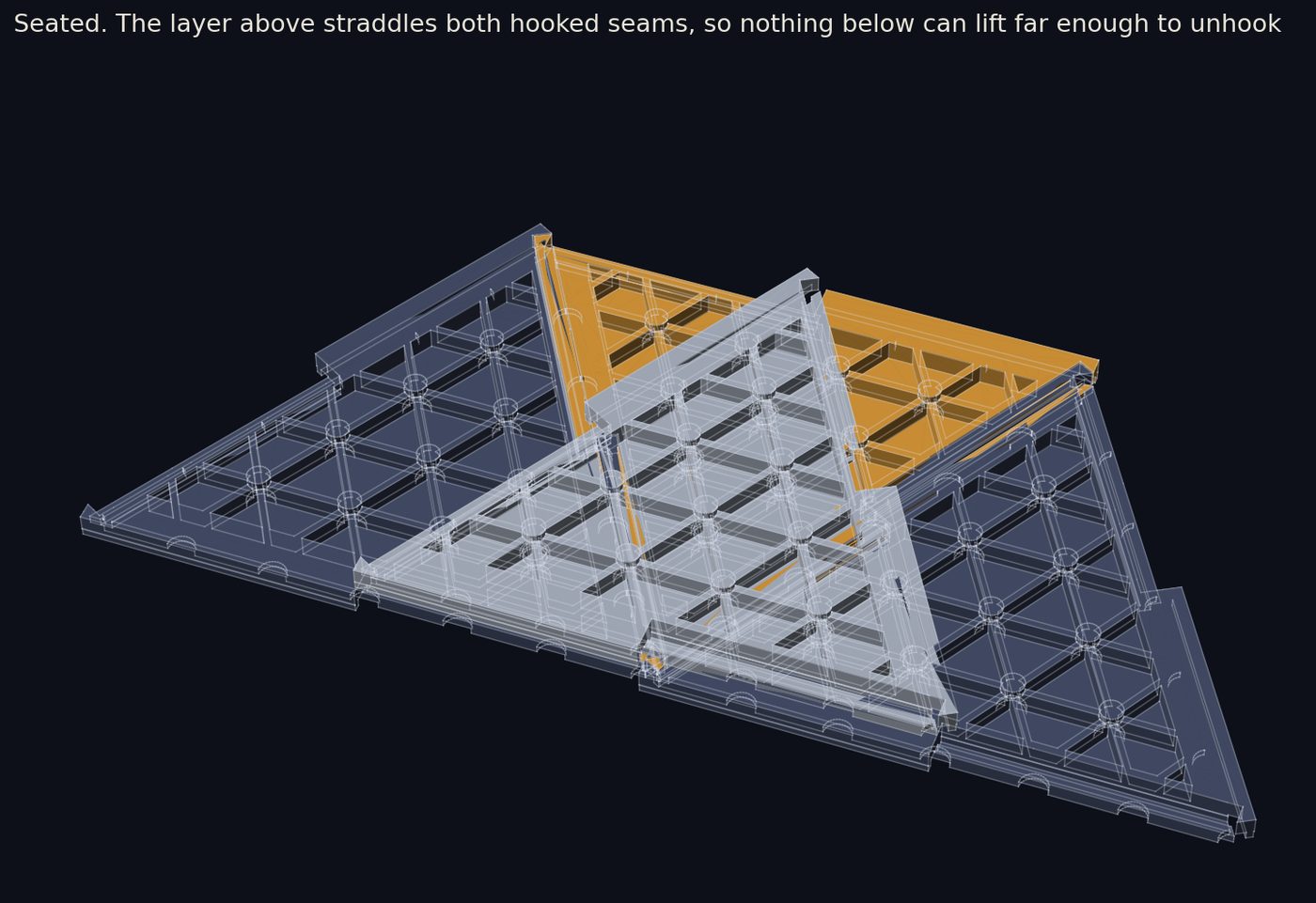
On the top face there are round studs at the rib intersections. On the underside there are matching sockets. The next layer of panels goes on shifted half a panel over, so it straddles every seam below it, and the studs drop into the sockets and carry the shear between the layers in every direction. If you have ever built anything out of a certain Danish toy you already understand the whole system. Thickness comes from stacking, not from printing thicker. One part, one file, forever. Need a stronger wall, send more panels.
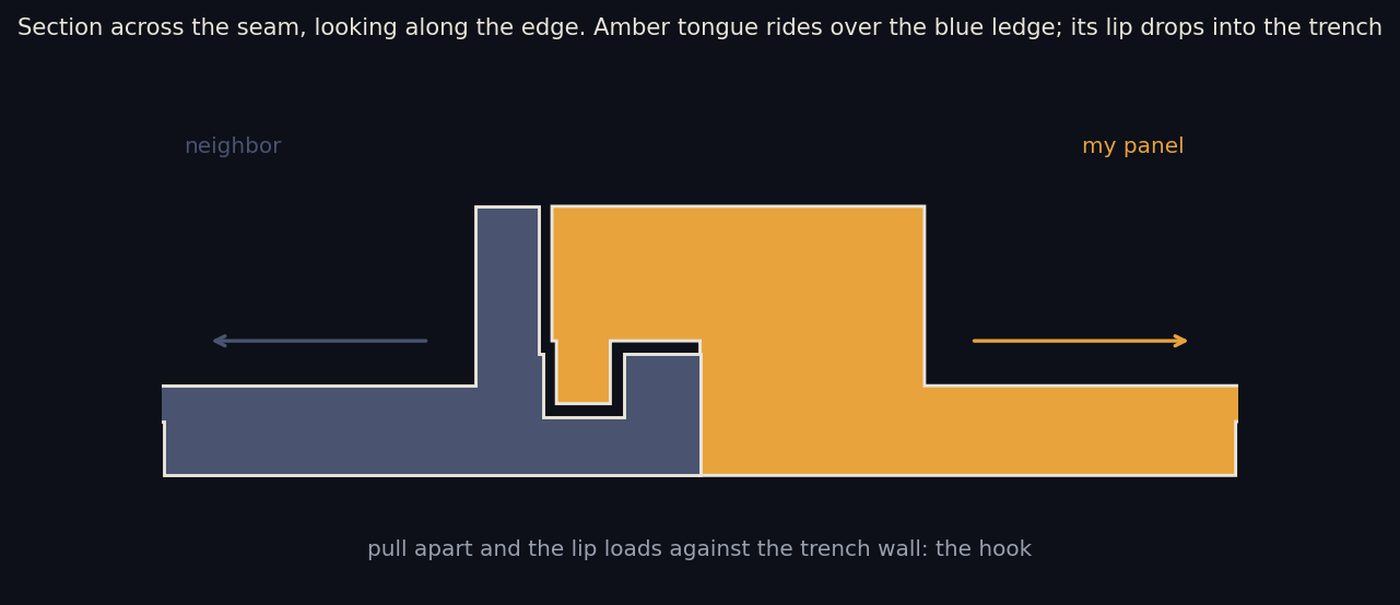
The edges lock with a hook. Each edge is half tongue and half groove, and because every other triangle in a row is turned over in plan, tongue meets groove on both halves. The tongue rides over its neighbor's ledge and a lip at its tip drops into a trench, so the two cannot be pulled apart in the plane of the wall. Everything assembles straight down, no sliding, which is what you want if a robot arm is doing it. And the layer above, sitting on the studs, is what keeps the layer below from lifting far enough to unhook. The structure holds itself. There is not a bolt in it.
And a number, since I started with one. If you stack two of these panels rib to rib, you get something like four tenths of an inch of solid stainless skin in the load path, ignoring the ribs entirely. Put that into the same formula, at one atmosphere, and the cell it can hold is about forty meters across. Roughly a hundred and thirty feet. Three layers and it is bigger. I do not trust that number very far, because it assumes the joints are as strong as the skin, and they are not, and finding out how much weaker is the whole point of the bench test. But it tells me the scale we are actually talking about. A cell a hundred feet across is not a cathedral. It is a very large room, and a cluster of very large rooms is a town.
Metal goes wherever the load is permanent or the temperature is high. Plastic goes everywhere else: partitions, trays, ducts, lockers, the fit-out of a room. The reason is not outgassing, which is what everyone asks about first. Dry engineering plastics pass the NASA screening test, and inside a pressurized hull, with air on both sides of the panel, there is nothing for a stray molecule to contaminate anyway.7 The reason is creep. A plastic floor plate under a one-gravity load for twenty years sags, slowly, and does not sag back. Radiation makes it brittle and the day-night thermal cycling works the joints. So the floor is steel and the locker is nylon, and that is the same rule every camp I have ever lived in already follows.
What we do not know
Shielding. I have not solved it and I am not going to pretend I have. Mass is the only real answer to radiation, and there is no clever substitute for thickness. The trouble is where to put it. It cannot ride on the outside of a spinning hull, because the spin flings it outward and the hull ends up carrying the shield's whole weight in tension on top of the air. The 1975 study got around that by wrapping the torus in a passive shell of lunar rubble that does not spin with it.8 That works if you have the Moon. The other route is my father's rock: spin the habitat inside a hollowed asteroid, and the shielding is already there, and you did not launch it. I think that is right, and I also think it is a long way off, and I do not have a good answer for the first habitat. If you do, I want it.
The seal. Every joint in this system is a mechanical joint, and mechanical joints leak. A running bond of hooked triangles may be a wonderful structure and a terrible pressure vessel. I suspect the honest design is a bladder or a welded liner on the inside, with the panels as the structure that holds the liner's shape, the way a pool has a liner and a wall. But suspect is all I can do from here, and a bench, a bicycle pump, and a dozen printed panels would tell us more than another month of my arithmetic.
The lips. The hook works because a lip about a seventh of an inch deep sits in a trench. That is the weakest feature on the part, and it will be the first thing to shear. If it does, the fix is to deepen the rim and the lip together, which is one number at the top of the file. But somebody has to break one first.
The joint angle. The panels are flat and the curve lives between them. I have not yet modeled how the hook has to tilt to close a ring, and it may be that the tongue needs a small angle built into it for a given cell radius, which would mean a slightly different file per radius. That would be a real cost, and I would rather know now.
Does anybody have a better idea?
I am asking that as a plain question, not as a rhetorical one. Everything above is the best I have been able to do with a spreadsheet, a few hundred lines of code, and forty years of putting other people's equipment together in the cold. It is a proposal. The parts I am most sure of are the ones the formula gives me, and the parts I am least sure of are the ones I made up.
So here is the invitation, and it is the same one as last week, except this time there is a file. Print the panel. Two of them, in whatever plastic you have. See whether they hook, whether the studs seat, whether the lip survives being pulled. Then tell us. If you are an engineer who knows why the cable lattice will not work, tell us that. If you work on a vessel shop floor and you know what a mechanical joint actually leaks at, tell us that. If you have a better answer for the shield than "wait for the Moon," we would very much like to hear it.
The dream is still a place with a sky. What I have learned this week is that the way to it is probably a lot of rooms first, built from a lot of small parts, by a lot of people who each did one thing well. That sounds less like a cathedral and more like a town. I can live with a town.
From one explorer to another, we appreciate you reading this far. We are excited about what this endeavor brings, and we would like you along for the rest of it.
Come join us. Because we are Star Bound.
John LangEditor
Ideas in Star Bound are published open — take them, build them better. Our open proposal.
A note on where this comes from. I am not a metallurgist, a spacecraft engineer, or a degreed engineer of any kind. But I am a practical one, with more than forty years in heavy industrial construction: welding, millwright work, hydraulics, mining, and thirty-three years of electrical construction and commissioning on the North Slope of Alaska, in a place that punishes anything built wrong. Much of that time I have worked as a field engineer, which means I am the one standing in front of the equipment when the drawing turns out to be wrong, and the fix has to be made on the spot, with what is on hand, and has to work the first time. Anyone who has done that long enough learns that a lot of engineering gets corrected in the field by people with more experience than the people who drew it. That is the eye I bring to these subjects: not what should work on paper, but what actually gets built, and what breaks. The facts I take from other people are footnoted so you can check them and read further. The ideas built on top of those facts are my own, and I would rather see them knocked down by somebody who knows better than left standing because nobody looked.
Sources
- A Thousand Garages, Star Bound, September 2026 — the distributed-printing proposal this piece follows from. ↩
- Richard D. Johnson and Charles Holbrow, eds., Space Settlements: A Design Study, NASA SP-413 (1977) — the 1975 Ames/Stanford summer study, which assumed roughly half of sea-level pressure inside the habitat. ↩
- Gerard K. O'Neill, The High Frontier: Human Colonies in Space (1976) — lunar material delivered by mass driver as the source of habitat structure and shielding; discussed in Bones Don't Travel Well. ↩
- NASA SP-413, Appendix A, Structural System — stressed-skin aluminum at 200 MPa working stress, major radius 830 m, tube radius 65 m; and Miklosovic et al., Autonomous Restructuring of Asteroids into Rotating Space Stations (2023), which restates the torus shell at 1.68 cm and half sea-level pressure. ↩
- NASA Exploration Atmosphere — the 8.2 psia, 34 percent oxygen habitat atmosphere evaluated for Artemis-era surface operations to shorten spacewalk prebreathe. ↩
- NASA, 50th anniversary of NASA deciding on a mixed-gas atmosphere for Apollo; Smithsonian Air & Space, Apollo's Worst Day — the pure-oxygen 16.7 psi pad atmosphere, the fire, and the material and atmosphere rules that followed. ↩
- Master Bond, NASA Low Outgassing (ASTM E595) — the screening test: 24 hours at 125 °C in vacuum, pass at under 1 percent total mass loss and under 0.1 percent condensables; the concern it addresses is contamination of optics and electronics. ↩
- NASA SP-413, Space Settlements: A Design Study — the passive, non-rotating shield of lunar material surrounding the rotating torus. ↩
The hoop-stress relation, the spin-stress relation for a self-supporting shell, and the wall thickness, weight, launch-count, and cell-size figures in this piece are my own hand arithmetic from those two formulas, rounded, and are meant to give scale, not to size anything. The cell-cluster proposal, the triangular isogrid panel, the stud-and-socket running bond, and the hooked edge are my own and are unreviewed. The panel files linked above are Rev 49 of that design.
More from Star Bound
- Top of the Loop, Bottom of the LoopThe two animals nobody budgets for, and what happened the last time we forgot them
- Light Is the ThrottleWhat a mine in Idaho and a garden in Alaska taught us about growing things fast — and what continuous daylight does to a plant that never gets to sleep
- Commission It FirstWe have already run phase one. It cost one man 150 million dollars of his own money, and it very nearly killed the people inside.
- Life in the BarrelO’Neill gave us the barrel in 1976 and got very little of it wrong. What he did not finish was the inside — and the standard the inside has to meet isn’t twenty years. It’s forever.
- Worms: The Backbone of CivilizationWhy the first Martians will need a bucket of worms more than another rocket
- Send the Robots FirstWhy the road to Mars runs through the moon, and why the first lunar miners will never leave Earth
- Wet the Ground and WaitA passive water generator for the desert, and why we should build one before we need one on Mars
- Send the Refinery, Not the OreWhy the belt gets mined by factory ships, and why that is the one job we cannot run from a chair
- Grind the Asteroid, Print the PartWhy there will never be a steel mill in space, and what replaces it
- A Thousand GaragesBefore there is a printer in space, there has to be a shipyard on the ground, and the shipyard does not have to be in one place
- Powder or WireThe two ways to print metal, why neither one is ready for the Belt, and the questions somebody has to answer first
- Bones Don't Travel WellThe one problem no rocket solves, and why Gerard O'Neill worked out the answer in 1976
- Blow the Rock Like GlassMy father's answer to how you build something big enough to spin, and the man who worked it out in 1963
- Built for Earth, or Built for Something Bigger?The tools a colony needs are being perfected right now, by people who say they are building them for us
- Mission Watch: September 2026What private enterprise and the agencies actually did this summer, in the order that matters
- The Question I Asked Buzz AldrinIn 1996 I asked the second man on the Moon what part private enterprise would play in space. Thirty years later, the answer is checkable
- Fish, Salt, or DirtThree ways to feed a habitat, what each one costs you, what each one can't survive, and a question for the reader.
- Thirty Thousand Volts and a Piece of Tin FoilI drove an hour and a half to call a man a liar. He turned on a computer monitor instead, and I have been thinking about it for twenty years.
- A Message in a Bottle, Thrown HardEvery article in this magazine is about how to build something. This one is about how to pay for it.
- The Box Nobody TestedIn 1991 eight people were sealed inside three acres of glass to prove a closed world could keep them alive. It nearly didn't, and the reason was sitting in the walls the whole time.
- Out the Side of the MountainTwenty miles of vacuum tube under a Hawaiian volcano, and a freight train that never comes back down. What a ground-based mass driver would actually take, and why it exits the flank instead of the summit.
- That’s Not a Rocket, It’s a Freight TrainHow I wired the one on my bench in 1994, the one I drew and never built, and why a mass driver runs on railroad logic, not rocket logic.
- Launch the Parts, Not the ShipYou cannot launch a habitat big enough to spin. So you launch a shipyard, and you let the robots build it.
- Cold, Vacuum, and a Hundred Thousand JointsWhat geosynchronous orbit does to the ten-inch panels in "A Thousand Garages," starting with the question every steel man asks first — and one thing that article got wrong.
- One Press or Ten ThousandElon Musk casts a car underbody in one shot with a machine the size of a house. We proposed ten thousand garages. It turns out we may both be right, on different walls — but nobody knows until somebody breaks fifty panels on purpose.
- Cast It or Print ItThree ways to make a hundred thousand habitat panels. What each one buys you, what each one costs you, and where each one belongs. The first entry in a department that exists to write both columns down.
- Powder or PlateThe garages stay. What's in them changes.
- Refuel It or Strip ItThe graveyard belt is the closest junkyard we've got.
Comments
Star Bound is not a forum, so comments run the old way: if you have comments, please write to us at hello@starboundmagazine.com and they will be published here in the next update, with your name on them. Say if you would rather stay anonymous.
No comments posted on this one yet. Yours could be the first.